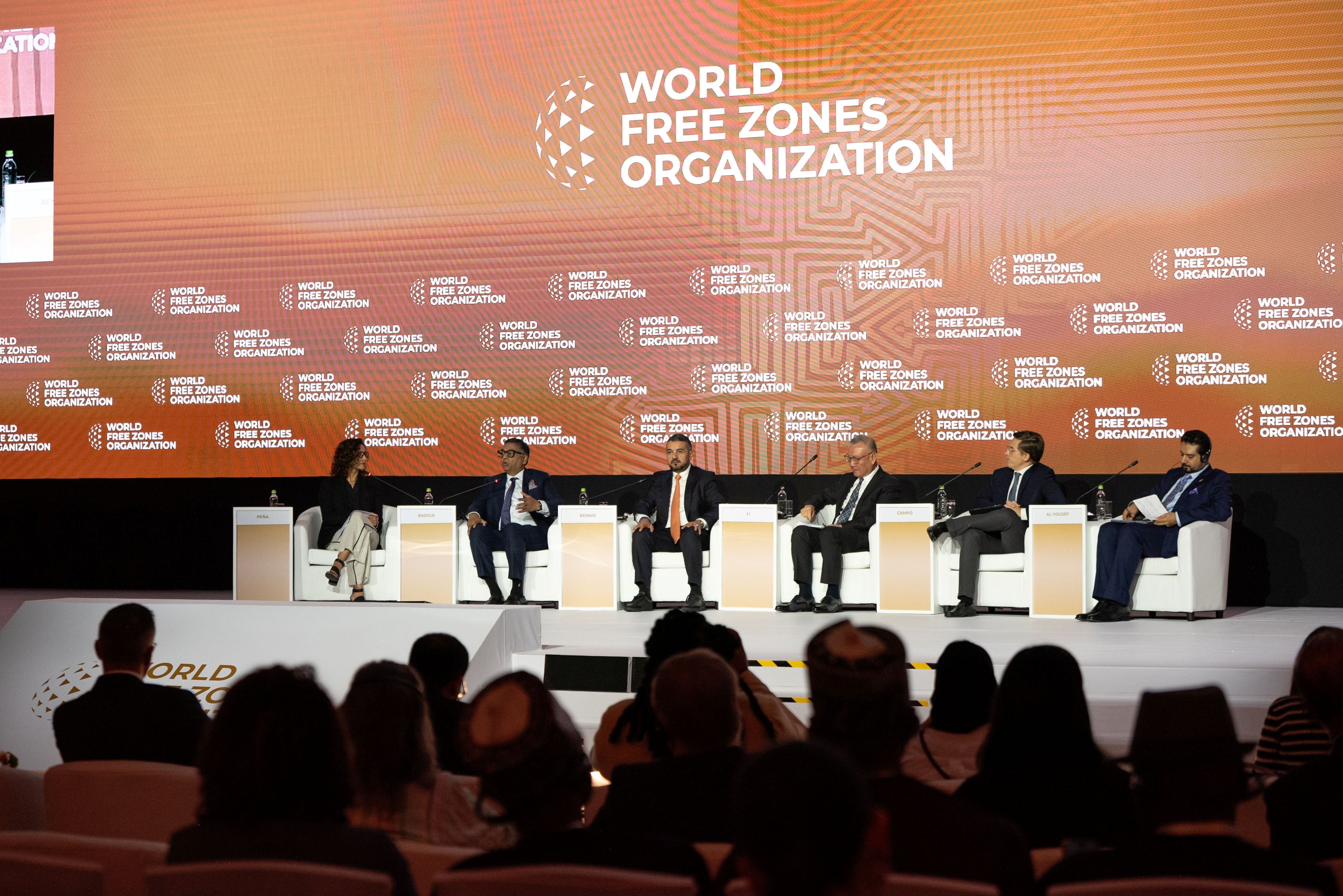


World Free Zones Organization 12th World Congress Concludes Successfully in Panama

The World Free Zones Organization (WFZO) successfully concluded the 12th edition of its annual World Congress in the Republic of Panama, bringing together over 2,000 business leaders, experts, CEOs of economic zones, international organizations, and senior government officials from 70 countries, including 27 ministers, reflecting the event’s position as a global platform shaping the future of free zones and economic zones worldwide.
The closing ceremony of the congress commenced with a speech by the Minister of Commerce and Industries, Julio Moltó, in which he conveyed the gratitude and appreciation of the President of the Republic of Panama, José Raúl Mulino, to the World Free Zones Organization and His Excellency Dr. Mohammed Al Zarooni, Chairman of the World Free Zones Organization, for the successful organisation of the congress activities.
The final day featured the Annual General Assembly meeting, during which a set of strategic resolutions aimed at enhancing the organisation’s operational framework and strengthening its global network of free zones was adopted. Elections were also held for the WFZO Board of Directors for a new term.
Vice Minister Anibelca Mena and Ambassador Roberto Salcedo of the Dominican Republic received the flag from H.E. Dr. Mohammed Al Zarooni, signifying the Dominican Republic’s role as the host of the 13th Annual World Congress in 2027, while the United Arab Emirates will host the 2028 edition in Dubai.
Ministerial Meeting
The event also hosted a high-level ministerial meeting, attended by H.E. Karin Herrera, Vice President of Guatemala, during which ministers highlighted the growing importance of zones as practical tools for supporting industrial policies, accelerating economic transformation, attracting investment, and enhancing competitiveness.
Discussions focused on the impact of geopolitical shifts, supply chain realignment, digital transformation, and sustainability requirements on the future of economic zones. Participants emphasized the importance of transitioning free zones from traditional incentive-based models into integrated industrial ecosystems that support innovation, renewable energy, green infrastructure, and circular economy principles.
H.E Dr. Mohammed Al Zarooni, Chairman of the World FZO, said: “The 12th edition of the World FZO World Congress in Panama marked a key milestone in the organization’s journey, bringing participants from around the world in an international dialogue that reflects the growing role of free zones as engines for trade, investment, innovation, and economic development. The discussions, partnerships, and exchange of expertise witnessed over the past few days reaffirm the importance of collective action in building a more resilient, sustainable, and future-ready global economic ecosystem.”
He added: “The World FZO, headquartered in Dubai, continues to expand its international presence and strengthen its role as a unifying platform for governments, economic institutions, and free zones around the world, contributing to the development of new models for cooperation and growth.”
Sessions and Workshops
The Congress featured a series of panel discussions and specialised workshops exploring the future of free zones and the transformations shaping global trade and investment flows.
Sessions titled “The New Global Operating Model - Leadership in Times of Transformation,” “Global Gateways - Redefining the Future of Trade and Global Connectivity,” and “Sustainability as a Competitive Edge – The Green Industrial Transition” examined the impact of economic, technological, and geopolitical shifts on supply chains and logistics connectivity.
The sessions also explored topics related to AI-driven manufacturing, digital transformation, sustainable infrastructure, eco-industrial zones, and the role of economic zones in supporting innovation, strengthening regional integration, and developing modern value chains and production networks.
Specialised discussions further addressed new operational models for free zones, public-private partnerships, and the development of knowledge- and technology-driven business environments, alongside investment opportunities across logistics, tourism, agribusiness, and the knowledge economy sectors.
Dubai’s Strategic Role
The UAE’s hosting of the 2028 edition in Dubai, and the 2027 Congress in Dominican Republic, reflects the country’s strategic role in supporting global economic dialogue and reinforcing its position as an international hub for free and economic zones.
The World FZO’s annual World Congress serves as a global platform that brings together decision-makers, leaders of economic zones, and international institutions to discuss the future of trade and investment, develop more resilient and sustainable economic models, and strengthen the role of these zones as key drivers of economic diversification, industrial development, and cross-border economic integration.
Memoranda of Understanding
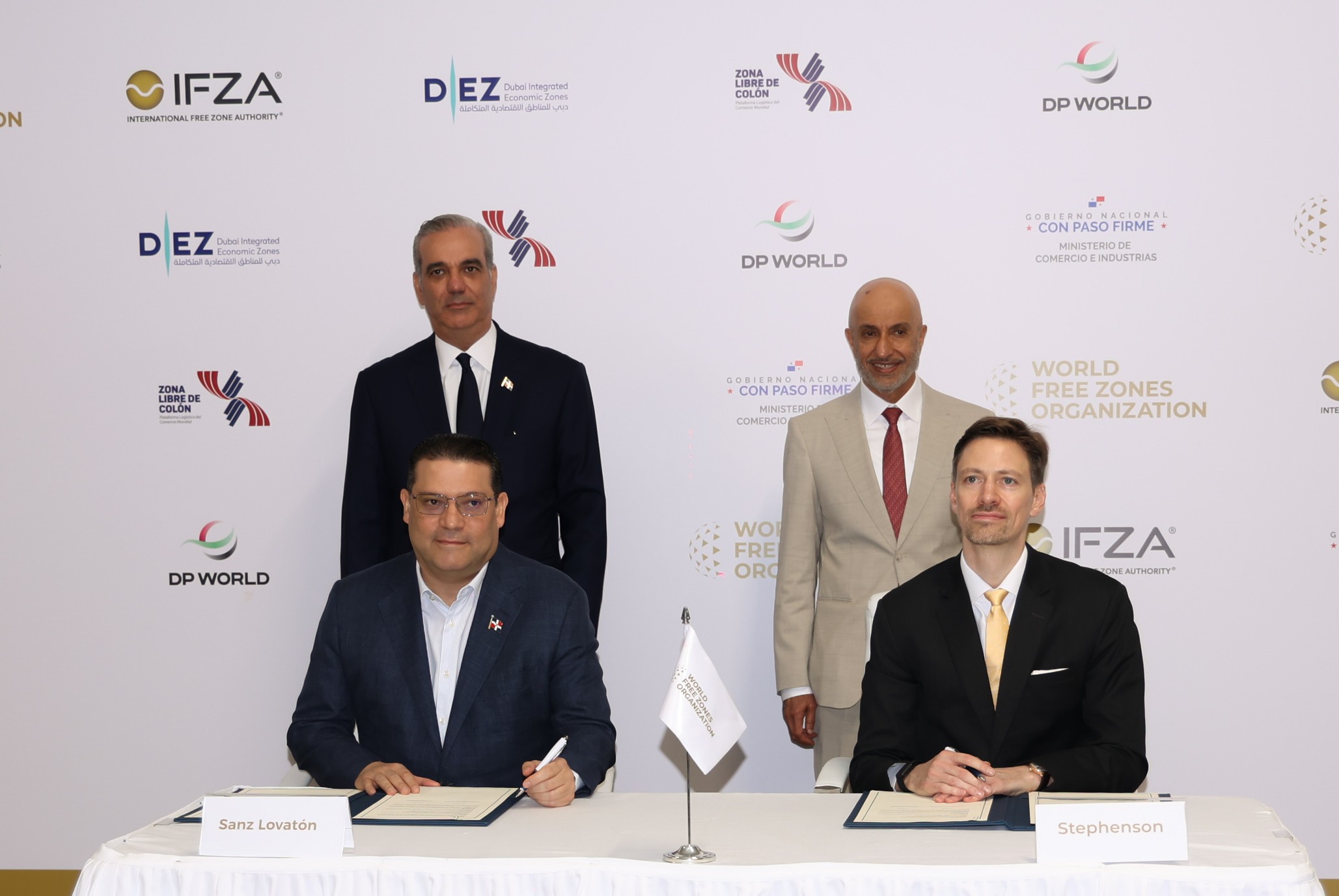
The Congress featured the signing of a Memorandum of Understanding (MoU) between the Ministry of Industry, Commerce and MSMEs (MICM) of the Dominican Republic and the WFZO, witnessed by His Excellency Luis Abinader, President of the Dominican Republic, and Dr. Mohammed Al Zarooni, Chairman of WFZO, and signed by H.E. Eduardo Lovaton, Minister of MICM and Dr. Matthew Stephenson, CEO of the WFZO, aiming at strengthening cooperation in the development of zones, encouraging investment, and facilitating the exchange of expertise and knowledge, while supporting the development of more sustainable and inclusive economic ecosystems.
The Congress also featured signing of a Memorandum of Understanding to create a new regional association of zones in the Caribbean. The Caribbean Special Economic Zone Association (Cari-SEZA) will focus on advancing the modernization, strategic development, regional trade and investment cooperation through SEZs across the Caribbean. The founding signatories from Jamaica, St. Lucia, the Dominican Republic, Aruba, Grenada, Trinidad and Tobago and the regional body the Caribbean Association of Investment Promotion Agencies, represent the geographic, linguistic and zone diversity of the region, with more countries having signalled their plans to join.
Tourism SEZs
At the World Congress, UN Tourism and the WFZO launched a joint report on Tourism Special Economic Zones (SEZs). The report, through surveys, case studies, and new analysis, presents how existing zones can be oriented to enable investment into tourism, as well as the opportunity to launch new zones specifically oriented towards tourism. The report creates a foundation for future dialogue, possible technical cooperation, policy innovation, and further analytical work related to Tourism SEZs. This is a first step toward identifying good practices and exploring how TSEZs can be adapted to different national and regional realities.
More on these topics
Most Recent News

DWTC Free Zone Records Strong Growth in 2025 with 41% Increase in New Licences and Workforce Surpassing 8,000

Dubai Holding to deliver first enterprise-scale AI deployment of its kind in the Middle East and Africa supported by Microsoft




 For an optimal experience please